Setting up a new hospital in India requires meticulous financial planning, particularly when it comes to medical equipment procurement. With costs ranging from lakhs to crores of rupees, understanding your options and creating a strategic budget aligned with Indian healthcare regulations can determine your facility’s financial viability.
Understanding the Indian Healthcare Equipment Market
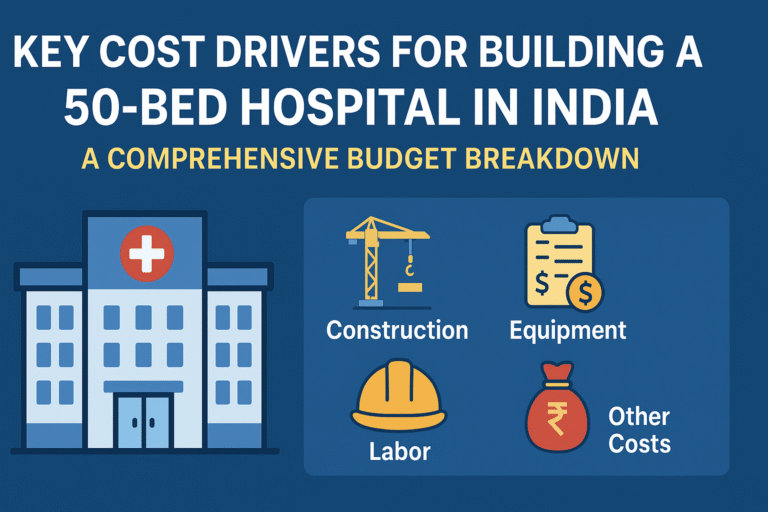
Medical equipment typically represents 15-20% of a hospital’s total startup costs in India. For a 50-bed hospital, this translates to approximately ₹2-5 crores, while a 100-bed facility may require ₹5-15 crores in equipment investments. The Indian medical equipment market, valued at over $11 billion, offers diverse procurement options catering to different budget levels.
Creating Your Equipment Budget Framework
Categorize by Priority Level
Start by dividing equipment into three tiers based on operational necessity and regulatory requirements:
Critical Equipment forms the backbone of patient care and must meet Clinical Establishment Act standards. This includes imaging systems like CT scanners and digital X-ray machines, operation theatre equipment, ICU ventilators and monitors, emergency room essentials, and sterilization equipment. These items typically represent 50-60% of your equipment budget and are essential for obtaining hospital registration.
Essential Equipment supports day-to-day operations and quality patient care. This category encompasses laboratory analyzers, ultrasound machines, ECG systems, patient beds and stretchers, examination tables, and basic surgical instruments, generally accounting for 25-30% of your budget.
Supplementary Equipment enhances patient comfort and operational efficiency. Administrative IT systems, waiting area furniture, physiotherapy equipment, and patient comfort items occupy the remaining 15-20% of allocated funds.
Assess Total Cost of Ownership
Indian hospitals must factor in unique cost considerations beyond the purchase price. Installation and civil work costs can add 12-18% to equipment prices, especially for imaging systems requiring radiation shielding. Staff training expenses are crucial given varying skill levels across regions. Annual Maintenance Contracts (AMCs) typically cost 8-15% of purchase price annually. GST at 12% or 18% depending on equipment classification significantly impacts budgets. Import duties for foreign equipment add 7.5-20% to costs. Factor in power backup requirements, as most critical equipment needs UPS or generator support.
New Equipment: The Premium Choice
Purchasing new equipment offers distinct advantages for Indian hospitals seeking reliability and compliance with National Accreditation Board for Hospitals standards.
Benefits of Buying New
New equipment comes with manufacturer warranties typically lasting 1-2 years with AMC options thereafter. You gain access to latest technology compliant with revised BIS standards and Drug Controller General of India requirements. Full technical support and training help address India’s skilled technician shortage. New purchases often include installation and commissioning, critical for complex equipment. You maintain complete service history for NABH accreditation requirements.
Cost Considerations
Indian-made equipment costs 30-50% less than imported alternatives while meeting quality standards. Import duties add significantly to foreign equipment costs but may be justified for specialized technology. GST input credit can be claimed, reducing effective cost by 12-18%. Negotiate payment terms including post-dated cheques or 30-60 day credit periods common in Indian B2B transactions.
Where to Source New Equipment in India
Domestic Manufacturers: Companies like BPL Medical Technologies, Trivitron Healthcare, Poly Medicure, Hindustan Syringes & Medical Devices, Oxymed, and Phoenix Medical Systems offer quality Indian-made equipment at competitive prices with strong service networks.
Authorized Importers and Distributors: Established distributors like Wipro GE Healthcare, Philips India, Siemens Healthineers India, and Fujifilm India provide imported equipment with local service support and warranty coverage.
Government e-Marketplace (GeM): Registered hospitals can access competitive pricing and transparent procurement through the GeM portal, which offers various medical equipment with standardized specifications.
Medical Equipment Exhibitions: Events like Medical Fair India (Mumbai), India Medical Device Conference (Delhi), and Medicall Expo provide opportunities to compare products, negotiate deals, and establish vendor relationships.
Leasing: Flexibility Meets Affordability
Equipment leasing is gaining traction in India, particularly for expensive diagnostic equipment, though the market remains smaller than in Western countries.
Types of Leasing Arrangements
Operating Lease: Functions like a rental agreement with lease payments treated as operational expenses. Terms typically run 3-5 years with options to upgrade or purchase. This structure suits equipment with rapid technological obsolescence.
Finance Lease: Similar to a financed purchase where you eventually own the equipment. You can claim depreciation benefits while spreading costs. Preferred for equipment with longer useful life.
Sale and Leaseback: Some hospitals sell existing equipment to leasing companies and lease it back, freeing up capital for operational needs.
Financial Advantages
Leasing preserves scarce capital for staffing, consumables, and working capital needs. Monthly payments align with revenue generation from equipment use. Lease rentals can be claimed as business expenses for tax purposes. Technology upgrades become easier, avoiding obsolete equipment burden. No collateral required beyond the equipment itself in most cases.
Leasing Providers in India
NBFCs specializing in healthcare: Bajaj Finance, Tata Capital Healthcare Finance, HDFC Healthcare Finance, and Cholamandalam Healthcare Finance offer equipment leasing with industry expertise and flexible terms.
Manufacturer financing: Siemens Financial Services, Philips Capital, and GE Capital provide competitive rates and streamlined approval processes, often bundled with equipment sales.
Public sector options: SIDBI offers equipment financing schemes for MSME hospitals, while State Financial Corporations provide equipment loans at subsidized rates.
Used and Refurbished Equipment: Value Without Compromise
The Indian refurbished medical equipment market offers substantial savings, with quality equipment available at 40-70% below new prices, making advanced technology accessible to smaller hospitals.
When Used Equipment Makes Sense
Consider refurbished options for proven technology where clinical performance remains excellent. Nursing homes, polyclinics, and smaller hospitals can acquire essential equipment within limited budgets. Backup systems for larger hospitals reduce costs without compromising primary care capabilities. Rural and tier-2/3 city hospitals can access technology otherwise financially out of reach.
Quality Assurance Factors
Verify equipment meets Drugs and Cosmetics Act requirements and has valid Drug Controller General of India certification for imported items. Insist on warranties of at least 6-12 months from reputable refurbishers. Request detailed service history and remaining useful life assessment. Confirm availability of spare parts in India, as some older models face supply issues. Ensure compliance with BIS standards where applicable.
Trusted Sources for Used Equipment in India
Certified Refurbishers: Companies like Kiran Medical Systems (Mumbai), Medisave (Pan-India), Hospital Equipment Company (Bangalore), and Hospimedica International specialize in refurbished equipment with quality certifications.
OEM Certified Pre-owned: Philips Certified Pre-Owned, GE Refurbished Systems, and Siemens Ecoline offer factory-refurbished equipment with manufacturer backing.
Hospital Upgrades and Liquidations: Corporate hospitals upgrading equipment often sell used systems in good condition. Healthcare equipment brokers facilitate these transactions.
Import of Used Equipment: Subject to DGFT regulations and age restrictions (typically equipment under 10 years old), imported refurbished equipment from developed markets offers advanced technology at reduced prices.
Building a Balanced Equipment Portfolio
Indian hospitals increasingly adopt mixed procurement strategies optimizing cost and quality.
Strategic Allocation Model
Invest in new equipment for critical, high-utilization items essential for NABH/NABL accreditation and where warranty support is crucial. Indian-made equipment offers excellent value for standard requirements.
Consider leasing for expensive imported diagnostic equipment like MRI and CT scanners where capital preservation is vital and technology evolves rapidly.
Choose used equipment for mature, proven technology, backup systems, and departments with lower patient volumes. Refurbished ultrasound, X-ray, and laboratory equipment offer excellent value.
Real-World Example for Indian Context
A 75-bed multispecialty hospital in a tier-2 city with ₹8 crore equipment budget might allocate as follows:
₹4 crores for new equipment: Indian-made operation theatre equipment, ICU ventilators and monitors, sterilization equipment, digital X-ray system, and basic laboratory analyzers.
₹2.5 crores leased equipment: Imported CT scanner and ultrasound systems on 5-year operating lease preserving capital and enabling upgrades.
₹1.5 crores certified used equipment: Refurbished patient monitors, backup X-ray system, examination tables, minor surgical instruments, and laboratory support equipment.
Financing Strategies and Funding Sources in India
Traditional Financing Options
Term Loans from Banks: Scheduled commercial banks offer healthcare equipment loans at 10-13% interest with tenure of 5-7 years. Priority sector lending benefits may apply for rural hospitals. MSME hospitals may access lower rates under government schemes.
NBFCs: Specialized healthcare NBFCs provide faster approval and flexible terms, though at slightly higher rates of 12-15%. Equipment acts as collateral, reducing documentation requirements.
Manufacturer Credit: Many suppliers offer installment plans of 12-24 months, often interest-free or at nominal rates, built into equipment pricing.
Government Schemes and Subsidies
PMJAY Infrastructure Support: Hospitals empanelled under Ayushman Bharat may access subsidized financing for equipment upgrades.
State Government Healthcare Schemes: Many states offer capital subsidies of 25-40% for hospitals in underserved areas. Check with your State Health Department.
SIDBI Schemes: Equipment financing for MSME hospitals at concessional rates with partial credit guarantee coverage.
Skill Development and Training: NSDC provides grants for healthcare skill training, potentially covering equipment training costs.
Alternative Funding Sources
CSR Funding: Corporate Social Responsibility mandates under Companies Act make healthcare equipment a popular CSR category. Approach companies with healthcare CSR initiatives.
Charitable Trusts and Foundations: Organizations like Rotary, Lions Clubs, and healthcare-focused NGOs provide equipment donations or grants, particularly for rural and charitable hospitals.
Crowd Funding: Platforms like Ketto and Milaap have successfully funded medical equipment for charitable hospitals and specific treatment facilities.
Vendor Negotiation Tactics for Indian Market
Leverage Your Position
Timing: March (fiscal year-end) and quarter-ends see aggressive discounting as vendors meet targets. Festival seasons also bring promotional offers.
Volume Bundling: Combine requirements across departments or collaborate with nearby hospitals for group procurement, yielding 15-25% savings.
Payment Terms: Negotiate 30-45% advance, balance on installation and commissioning. Retention of 10% for 3-6 months ensures after-sales commitment.
Local Competition: Indian manufacturers offer significant price advantages. Use competitive quotes to negotiate better terms from premium brands.
Key Negotiation Points
Free Training: Insist on comprehensive staff training at your facility, saving ₹50,000-2 lakhs per equipment type.
Extended Warranty: Negotiate 2-year warranty instead of standard 1-year, reducing AMC costs in year two.
AMC Bundling: Lock in AMC rates for 3-5 years at purchase time, avoiding annual cost escalations of 8-12%.
Installation Inclusion: Ensure civil work, electrical fittings, and commissioning costs are included or clearly specified.
Spare Parts Kit: Request complimentary spare parts kit for first 1-2 years, particularly important given import lead times.
Planning for Ongoing Costs in Indian Context
Annual Operating Expenses
AMC Costs: Comprehensive AMCs cost 10-15% of equipment value annually but prevent expensive breakdown repairs. Choose wisely between manufacturer and third-party service providers.
Consumables: Calculate monthly consumable costs carefully as they significantly impact profitability. Negotiate consumable supply contracts with volume discounts.
Power and Backup: Major equipment like CT scanners consume substantial electricity. Factor in 24×7 power backup costs through UPS systems or generators.
Trained Technicians: Budget for trained biomedical engineers or technicians, or consider outsourced equipment management services increasingly available in metros.
Calibration and Quality Control: Annual calibration costs and quality control consumables are mandatory for NABL-accredited laboratories.
Equipment Replacement Planning
Medical equipment lifespan in Indian conditions varies: imaging equipment typically lasts 8-12 years with proper maintenance, operation theatre equipment 12-15 years, patient monitoring systems 6-8 years, and laboratory equipment 8-10 years. Indian conditions like power fluctuations and environmental factors may reduce lifespan by 10-20% compared to developed countries.
Establish a replacement reserve fund setting aside 8-12% of equipment value annually through depreciation accounting to prepare for eventual upgrades.
Regulatory Compliance in India
Mandatory Requirements
Medical Device Rules 2017: All medical equipment must comply with Medical Device Rules under Drugs and Cosmetics Act. Verify valid licenses from manufacturers and importers.
BIS Certification: Many medical devices require Bureau of Indian Standards certification. Check BIS website for mandatory certification lists.
Clinical Establishment Act: State-specific regulations mandate minimum equipment standards for hospital registration across specialties.
Biomedical Waste Management: Equipment generating biomedical waste must comply with BMW Management Rules 2016.
Radiation Safety: X-ray and CT equipment requires AERB (Atomic Energy Regulatory Board) licenses and compliance with radiation safety standards.
Accreditation Standards
NABH Requirements: National Accreditation Board for Hospitals mandates specific equipment standards, calibration records, and preventive maintenance schedules.
NABL for Laboratories: Laboratory accreditation requires validated, calibrated equipment with detailed documentation.
State-Specific Considerations
Regional Variations
Service Network: Tier-1 cities offer comprehensive service support for all brands. In tier-2/3 cities, prioritize brands with strong regional presence or choose Indian manufacturers with wider service networks.
Power Infrastructure: Areas with unreliable power supply require higher investment in UPS and generator capacity, adding 15-20% to equipment costs.
Skilled Manpower: Metropolitan areas offer trained technicians and operators. Smaller cities may require higher training investments and retention strategies.
Logistics: Remote areas face longer spare parts lead times. Consider equipment with lower failure rates and stock critical spare parts.
Technology Trends Affecting Indian Healthcare Budgets
Emerging Considerations
Make in India: Government’s push for domestic manufacturing is reducing costs for select equipment categories while improving local service support.
Telemedicine Equipment: Post-COVID acceleration of telemedicine requires investments in telehealth infrastructure, cameras, and connectivity solutions.
Digital Health Integration: Ayushman Bharat Digital Mission drives need for equipment with digital connectivity and health data exchange capabilities.
AI and Machine Learning: AI-enabled diagnostic equipment commands premium pricing but may improve outcomes and efficiency, with several Indian startups offering affordable solutions.
Mobile Health Units: Government schemes supporting mobile health vans create demand for portable, battery-operated equipment.
Making the Final Decision
Decision Matrix Approach
Evaluate equipment options across criteria relevant to Indian hospitals: clinical necessity and regulatory compliance, capital availability and cash flow impact, operational efficiency and revenue generation potential, service support accessibility in your location, consumable costs and local availability, staff skill levels and training requirements, and patient perception and marketing value.
Weight each factor according to your facility’s location, target patient segment, and strategic positioning.
Implementation Timeline
Phase equipment acquisition over 18-24 months aligning with hospital construction and licensing milestones. Prioritize essential equipment for initial Clinical Establishment registration, followed by accreditation-required equipment, then specialty department equipment, and finally supplementary and comfort-enhancing equipment.
Order long-lead-time equipment like MRI and CT scanners 4-6 months before expected installation dates to account for import and installation timelines.
Conclusion
Equipping a hospital in India requires balancing clinical excellence, regulatory compliance, and financial prudence within the unique constraints and opportunities of the Indian healthcare market. By strategically combining new Indian-made equipment, selective leasing of advanced imported technology, and certified refurbished equipment, you can create a comprehensive portfolio serving patients effectively while maintaining financial health.
The Indian medical equipment market offers unprecedented value and choice compared to a decade ago. Domestic manufacturing capabilities have improved significantly, reducing dependence on imports for many equipment categories. Government initiatives like Ayushman Bharat are expanding healthcare access, creating sustainable demand that justifies equipment investments.
Success requires thorough market research, understanding regulatory requirements, aggressive negotiation, and building relationships with reliable suppliers who will support your facility’s growth. Your equipment decisions will impact clinical outcomes, operational efficiency, and financial performance for years to come.
Remember that the cheapest option isn’t always the most cost-effective choice in Indian conditions. Consider total cost of ownership including consumables, AMC costs, power consumption, and service accessibility. Factor in climate, power infrastructure, and local skill availability when making final decisions.
With careful planning, smart procurement, and strategic vendor partnerships, Indian hospitals can acquire world-class equipment within reasonable budgets, delivering quality healthcare while maintaining financial sustainability.
Frequently Asked Questions
What is the typical equipment budget for a 50-bed hospital in India?
A 50-bed multispecialty hospital in India typically requires ₹2-5 crores for medical equipment, representing 15-20% of total project cost. This includes operation theatre equipment (₹60-80 lakhs), diagnostic imaging like digital X-ray and ultrasound (₹50-70 lakhs), ICU equipment (₹40-60 lakhs), laboratory setup (₹30-50 lakhs), and general ward equipment including beds and monitors (₹20-30 lakhs). The budget varies based on specialties offered, location, and whether you choose Indian-made or imported equipment. Tier-2 and tier-3 cities may reduce costs by 20-30% compared to metros due to lower civil work and installation charges.
Is it better to buy Indian-made or imported medical equipment?
This depends on equipment type and intended use. Indian manufacturers like BPL, Trivitron, and Phoenix offer excellent value for operation theatre equipment, patient monitors, and basic diagnostic equipment at 30-50% lower costs with strong domestic service networks. Import duties and logistics make foreign equipment 40-60% more expensive. However, for advanced imaging like MRI and CT scanners, imported equipment from Siemens, GE, or Philips often provides superior technology, though their Indian manufacturing facilities offer competitive alternatives. For NABH accreditation and patient confidence, mixing Indian equipment for standard needs with selective imported equipment for specialized diagnostics works best. Always verify BIS certification and regulatory compliance regardless of origin.
How can I verify the quality of refurbished medical equipment in India?
Verify that the refurbisher has valid Drug License for medical devices under CDSCO. Check for ISO 13485 certification or equivalent quality management credentials. Insist on warranty of at least 6-12 months from reputable vendors. Request complete service history, previous usage details, and remaining useful life assessment. Physically inspect equipment and test all functions before purchase. Confirm availability of spare parts through authorized dealers in India. Verify original manufacturer documentation and import records if applicable. Check online reviews and references from other hospitals. For expensive equipment, hire an independent biomedical engineer for pre-purchase inspection. Reputable refurbishers like Kiran Medical Systems and Hospimedica provide comprehensive documentation and post-sale support.
What government schemes can help with hospital equipment financing in India?
Several government initiatives support healthcare equipment financing. SIDBI offers equipment loans for MSME hospitals at concessional rates with credit guarantee coverage. State governments provide capital subsidies of 25-40% for hospitals in underserved areas under various health mission schemes. Ayushman Bharat empanelment may provide access to subsidized financing. NABH accreditation grants from Quality Council of India can offset equipment costs. Stand Up India scheme offers loans up to ₹1 crore for SC/ST and women entrepreneurs. MUDRA loans up to ₹10 lakhs suit small clinics and nursing homes. National Health Mission provides equipment support for facilities in tribal and remote areas. Contact your State Health Department and District Industry Centre for state-specific schemes with 30-50% subsidy potential.
Should I purchase or lease expensive equipment like CT and MRI scanners?
For most Indian hospitals, especially those with limited capital, leasing expensive diagnostic equipment makes financial sense. A 16-slice CT scanner costs ₹1.5-2.5 crores outright, while leasing costs ₹3-5 lakhs monthly, preserving capital for operations and staffing. Leasing provides technology upgrade options after 5 years, important as imaging technology evolves rapidly. Monthly lease payments can be offset against scan revenues, typically ₹2,500-4,000 per scan. However, if you have sufficient capital and expect high utilization (20+ scans daily), purchasing may prove economical over 7-10 years. Consider hybrid approaches: purchase a new or refurbished X-ray and ultrasound while leasing CT scanner. Location matters too—metro hospitals with consistent patient flow may benefit more from ownership, while tier-2/3 city hospitals might prefer leasing to minimize risk.
What are AMC costs and are they mandatory for medical equipment in India?
Annual Maintenance Contracts cover preventive maintenance, breakdown repairs, spare parts, and periodic calibration, typically costing 10-15% of equipment purchase price annually. While not legally mandatory, AMCs are practically essential for expensive equipment and are required for NABH accreditation and insurance validity. Manufacturers offer comprehensive AMCs including all parts and labor, or non-comprehensive covering only labor. Third-party AMC providers charge 20-30% less but may use non-genuine parts. For critical equipment like ventilators, CT scanners, and operation theatre equipment, manufacturer AMCs ensure reliability and preserve warranty. Smaller equipment like patient monitors and ECG machines can use third-party AMCs. Budget AMC costs from year one, as breakdowns without coverage can cost ₹2-5 lakhs per incident for imaging equipment. Many hospitals negotiate 3-5 year AMC rates at purchase time, saving 15-20% versus annual contracts.
How does GST affect medical equipment purchases in India?
Medical equipment attracts GST at 12% for most categories including X-ray, ultrasound, CT scanners, and surgical instruments. Some specialized equipment attracts 18% GST. Life-saving equipment like ventilators, dialysis machines, and certain cardiac devices attract 5% GST. The advantage is that registered hospitals can claim Input Tax Credit, effectively reducing costs if your services are GST-applicable. For example, a ₹1 crore CT scanner with 12% GST costs ₹1.12 crores upfront, but you can claim ₹12 lakhs as input credit against your GST liability on hospital services. However, if providing exempted healthcare services, you cannot claim credit, making GST a real cost. Some vendors offer composite schemes where they claim credit and reduce prices. Imported equipment faces customs duty (7.5-20%) plus GST on total landed cost, significantly increasing effective price by 25-35% compared to Indian-made alternatives.
Which medical equipment requires AERB approval in India?
The Atomic Energy Regulatory Board regulates all radiation-emitting equipment in India. X-ray machines, CT scanners, C-arms, mammography systems, bone densitometry equipment, and linear accelerators require AERB licenses before installation and operation. The process involves submitting detailed facility plans, safety features, and radiation protection measures, taking 2-4 months. You need a certified Radiological Safety Officer on staff. Installation sites require radiation shielding with lead lining, adding ₹5-15 lakhs to setup costs. Annual renewal fees apply, typically ₹2,000-10,000 depending on equipment type. Non-compliance can result in penalties up to ₹5 lakhs and equipment seizure. Vendors typically assist with documentation, but factor in 3-6 months for complete licensing before you can operationalize radiation equipment. Some states have additional radiation safety requirements under their Clinical Establishment Acts.
Can I import used medical equipment into India?
Yes, but subject to strict regulations. The Directorate General of Foreign Trade permits import of used medical devices under 10 years old from original manufacturing date. Equipment must have valid residual life and meet current Indian standards. You need Import Export Code, and items may require NOC from Drug Controller depending on classification. BIS certification is mandatory where applicable. Import duty ranges from 7.5-20% plus 12-18% GST on landed value, making total duty incidence 20-35%. Clearance requires detailed documentation: original invoice, year of manufacture certificate, working condition certificate, and sometimes pre-shipment inspection. Certain high-value equipment like MRI and CT scanners face additional scrutiny. Port clearance takes 2-4 weeks. Despite duties, importing refurbished equipment from developed markets can save 30-50% compared to new equipment in India. Work with experienced healthcare equipment importers who understand regulatory requirements and can navigate customs processes efficiently.
How do I choose between manufacturer AMC and third-party service providers?
Manufacturer AMCs cost 10-15% of equipment value annually but offer genuine parts, trained engineers, software updates, and liability coverage. They’re essential during warranty period and recommended for critical equipment like ventilators, anesthesia machines, CT scanners, and operation theatre equipment where reliability is non-negotiable. Third-party Multi-Vendor Service Providers charge 6-10% annually, offering cost savings of 30-40%. They’re suitable for mature equipment past warranty, standard ultrasound and X-ray systems, patient monitors, and laboratory equipment where parts are readily available. Consider hybrid approaches: keep manufacturer AMC for critical equipment while using third-party for non-critical systems. Evaluate third-party providers on response time (4-8 hours in your city), parts availability, engineer qualifications, and client references. For NABH accreditation, maintain proper service records regardless of provider. Some hospitals hire in-house biomedical engineers for routine maintenance while contracting specialized repairs, reducing costs by 40-50% for larger facilities with 50+ equipment units.
Transform Your Vision Into a
World-Class Hospital.
Hoscraft has helped doctors and healthcare entrepreneurs across India plan, design and build their dream hospitals. Let us help you too.